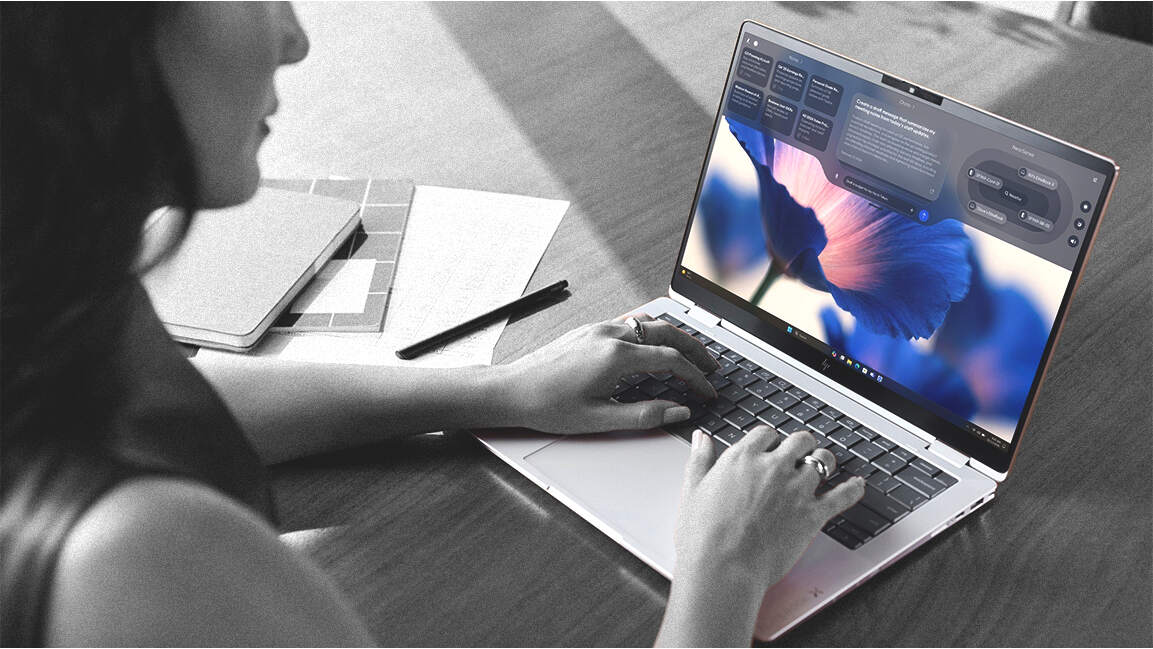
The commercial PC market has a long history of incremental evolution: each generation of products offers somewhat better performance, somewhat better battery life, and somewhat improved build quality, but the fundamental nature of the product — a laptop that runs Windows, that workers use to access their organisation's applications and data — changes relatively slowly. The integration of on-device AI processing capability is now challenging that pattern, and HP's updated commercial laptop line reflects the company's bet that AI functionality has become a meaningful differentiator in enterprise PC procurement.
HP's commercial portfolio — which spans the EliteBook line for premium enterprise users, the ProBook line for mid-market business deployment, and a range of workstation and specialised form factors — has been updated with neural processing unit (NPU) equipped processors across a larger share of the product range than in previous years. The company is pairing this hardware investment with an expanded suite of AI-powered software features, central management capabilities for IT administrators, and commercial partnerships with enterprise software vendors to integrate AI capabilities into common workplace applications.
The commercial PC business is intensely competitive, with HP facing established competition from Lenovo, Dell, and Microsoft in the enterprise market, as well as the increasing incursion of Apple's M-series Macs into enterprise deployments as macOS compatibility with enterprise software has improved. In this context, HP's AI-centred product positioning reflects a genuine strategic choice about where the company sees differentiated value, rather than simply following an industry trend.
What HP Is Shipping
The on-device AI features HP is highlighting in its updated commercial portfolio fall into several categories. AI-enhanced video conferencing capabilities — which use the NPU to run real-time background blur, noise suppression, auto-framing, and gaze correction for video calls — have become standard across most commercial PC vendors, and HP's implementation in its current generation is technically competitive with the field. These features are among the highest-visibility on-device AI capabilities for business users, given the centrality of video communication in post-pandemic work patterns.
HP is also promoting AI-assisted writing and meeting summarisation features that integrate with Windows' built-in AI capabilities and with its own HP AI Companion software. These features can transcribe and summarise meetings conducted through compatible conferencing applications, generate first-draft summaries of documents, and provide writing assistance within common productivity applications. The practical quality of these features depends heavily on the underlying models, and HP's implementation draws on both on-device models and cloud-connected services depending on the specific capability.
A category of features that has been less prominent in consumer AI discussions but which HP is emphasising for its commercial customers involves AI-assisted PC management and security. On-device AI can analyse device telemetry in real time to detect anomalous behaviour patterns that might indicate security incidents — unusual processes, unexpected network connections, abnormal file access patterns — without requiring all telemetry data to be routed to a remote security service for analysis. HP's Wolf Security platform, the company's endpoint security suite, has been updated to incorporate on-device AI analysis as a component of its threat detection architecture.
Predictive maintenance capabilities represent another enterprise-relevant on-device AI use case HP is developing. By analysing hardware sensor data — temperature readings, fan behaviour, battery charge/discharge cycles, storage health indicators — on-device AI can identify patterns that are associated with impending hardware failures and alert IT administrators or users before a failure occurs. For organisations managing large fleets of devices, the ability to proactively address hardware issues before they result in user downtime has meaningful operational value.
IT Deployment and Management
For enterprise customers, the experience of procuring and deploying technology is shaped as much by manageability and total cost of ownership considerations as by end-user features. HP's commercial AI story addresses this audience directly, emphasising the manageability of AI features across device fleets and the tools available to IT administrators for controlling which AI capabilities are enabled and how they operate.
Through HP's management platform and integration with Microsoft's endpoint management tools, IT administrators can configure which on-device AI features are active on managed devices, control whether AI features are permitted to connect to cloud services, and set policies around the retention and handling of AI-generated content. For organisations with strict data handling policies — particularly in regulated industries like financial services, healthcare, and government — this kind of granular administrative control is a prerequisite for deployment.
The on-device AI capabilities of the latest commercial PCs also interact with the broader Windows AI ecosystem that Microsoft has been developing. The Copilot+ platform requirements that Microsoft has established — specifying minimum NPU performance capabilities for devices to qualify for the full range of Windows AI features — shape which devices qualify for enterprise AI feature sets and have influenced HP's hardware choices in its commercial product line. HP's current commercial portfolio is largely designed to meet or exceed Copilot+ requirements across its main commercial product tiers.
Enterprise procurement cycles for PCs are long, typically operating on three-to-five year refresh timelines, and the installed base of AI-capable commercial PCs is currently a relatively small share of the total enterprise PC fleet. This means that IT departments are now managing an increasingly heterogeneous environment in which some users have NPU-equipped machines capable of running on-device AI features while others are on older hardware that is not. Managing this transition — deciding which AI features to enable, for which user populations, through which application integrations — is a practical challenge that HP's enterprise customers are navigating.
The Processor Platform Question
HP's commercial laptop line spans a range of processor platforms, and the AI performance of on-device AI features varies significantly across this range. Intel's Core Ultra processors, Qualcomm's Snapdragon X series, and AMD's Ryzen AI processors all offer NPU capability but with different performance levels, different software ecosystem maturity, and different trade-offs in terms of overall CPU and graphics performance. HP's product line currently ships models based on all three processor families, targeting different customer segments and use cases.
The Qualcomm-based models, which use ARM-architecture processors rather than the x86 architecture of Intel and AMD chips, have attracted particular attention for their AI performance and battery life but have also faced practical challenges around application compatibility. While the most common business applications are now available in native ARM versions or run satisfactorily through binary translation, some specialised enterprise software has lagged in ARM compatibility, creating friction in organisations with diverse software requirements.
Intel and AMD's NPU implementations have generally offered less raw AI performance than Qualcomm's dedicated NPU, but have the advantage of running in familiar x86 architecture environments with no application compatibility concerns. Both companies have been investing heavily in NPU capability in their processor roadmaps, and the performance gap has been narrowing. For IT buyers who prioritise application compatibility above all else, x86-based commercial PCs remain the lower-risk choice.
Software Partnerships and the Application Ecosystem
Hardware AI capability is only as useful as the software that takes advantage of it, and HP has invested in partnerships with enterprise software vendors to ensure that AI features are integrated into the applications most commonly used by its commercial customers. Microsoft 365 — the dominant productivity suite in enterprise environments — is a central integration target, with features like Copilot in Word, Excel, and Teams able to leverage on-device processing for some operations when running on capable hardware.
Beyond Microsoft, HP has partnerships with video conferencing platform vendors to ensure that AI calling features work seamlessly within those applications, with security software vendors for AI-powered threat detection integrations, and with a number of industry-specific software providers for vertically tailored AI features. The value of these partnerships lies in ensuring that the hardware AI capability HP is selling translates into visible, usable features in the software environments where HP's enterprise customers actually work.
The enterprise software market is also seeing a wave of AI feature additions from established vendors across many categories — HR software, CRM systems, ERP platforms, and professional tools of all kinds are integrating AI capabilities at varying rates and with varying quality. The on-device AI capabilities of commercial PCs are one architectural option for delivering these features, alongside cloud-hosted AI services. As enterprise software vendors make these architectural choices, the AI performance of the PCs their customers use becomes a more relevant procurement consideration than it has historically been.
Market Context: The Commercial PC Competitive Landscape
HP competes for commercial PC business against Lenovo, which holds the largest share of the global commercial PC market, and Dell, which is particularly strong in large enterprise accounts. Both competitors have made similar moves to emphasise AI capabilities in their commercial PC portfolios — Lenovo through its AI PC designation and ThinkAI initiative, Dell through its AI-ready commercial product positioning. The competitive differentiation between these players in the AI PC space is currently modest; all are shipping Copilot+-compliant hardware with similar NPU platforms and broadly similar feature sets.
The more structurally interesting competitive dynamic is the increasing presence of Apple's Mac platform in enterprise environments. Apple's M-series chips have demonstrated strong performance on AI inference workloads, and the macOS ecosystem for AI-enabled applications has developed significantly. Some enterprise customers who might previously have defaulted to Windows-only PC procurement are now managing mixed Mac and Windows environments, and Apple's retail and enterprise sales efforts have been active in positioning Macs as AI-capable business machines.
For HP and its Windows PC competitors, this means that the AI capability story needs to be compelling not just within the Windows world but relative to what Apple's platform offers. The software ecosystem advantages of Windows in enterprise contexts — the breadth of Windows-compatible enterprise software, the maturity of Windows-based IT management tools, and the larger installed base — remain significant competitive moats, but they are complemented by hardware AI capability arguments that HP and others are now developing.
What This Means for Enterprise AI Strategy
For IT decision-makers and enterprise technology strategists, the expansion of on-device AI capability in commercial PCs creates new architectural options and new considerations. Organisations that have been building their AI capability strategy around centrally hosted AI services — typically either cloud AI API services or on-premises AI server infrastructure — now have an additional option: distributing AI processing capacity to the endpoint devices in their fleet.
On-device AI processing has several potential advantages in enterprise contexts beyond the privacy and latency benefits that apply in consumer settings. Processing sensitive business data on-device rather than routing it through external AI services may be easier to square with data handling obligations, particularly where those obligations involve keeping data within specific geographic boundaries or limiting its exposure to third-party processors. On-device processing is also not subject to the per-query cost models that cloud AI services typically use, which may make certain high-frequency AI workloads more economically attractive to run on device.
Against these advantages, on-device AI processing is constrained by the capabilities of endpoint hardware, is more complex to manage and update than centrally hosted services, and creates a heterogeneous environment where different employees have different AI capabilities depending on the device they are using. A thoughtful enterprise AI architecture will likely involve a mix of on-device and cloud-hosted AI capabilities, with decisions about which tasks are best handled where driven by a combination of performance requirements, data handling constraints, and cost considerations.
HP's push on on-device AI in its commercial line is, at one level, a product marketing story — AI is currently the most compelling narrative in the technology market, and PC vendors need to participate in that narrative to remain relevant in enterprise procurement discussions. But the underlying technical capabilities are real, and they are opening up architectural possibilities for enterprise AI deployment that were not available two years ago. For organisations currently planning their AI infrastructure strategies, the trajectory of endpoint AI capability is worth factoring into the analysis.
AI-Powered Security: Wolf Security Updates
HP's Wolf Security platform has been central to its commercial PC marketing for several years, and the integration of on-device AI into the security capabilities of the platform is one of the more substantive enterprise-relevant developments in the current product update. The principle behind AI-enhanced endpoint security is that on-device models can analyse system behaviour in real time — monitoring process activity, file access patterns, network connections, and memory behaviour — to detect anomalies that may indicate malicious activity, without the latency and privacy implications of routing telemetry to a remote security service for analysis.
HP has integrated behavioural anomaly detection powered by the device's NPU into the threat detection component of Wolf Security. This supplements the signature-based detection (which identifies known malware based on characteristic code patterns) with a behavioural layer that can identify suspicious activity even from previously unseen threats that have no known signature. For enterprise customers operating in environments where sophisticated threats use novel techniques specifically designed to evade signature detection, this kind of behavioural analysis has genuine security value.
The privacy angle is also relevant in the enterprise context. Routing detailed endpoint behavioural telemetry to a cloud-based security service raises data handling questions for organisations with strict data residency requirements or information security policies that limit the transmission of internal system data to third-party infrastructure. On-device AI threat detection that does not require telemetry transmission can address some of these concerns while maintaining real-time detection capability.
HP has also developed AI-assisted sure recovery capabilities that use on-device analysis to detect when a system has been compromised and facilitate restoration to a known good state. The integration of AI into the recovery process — helping to identify the scope of a compromise and the appropriate recovery actions — adds capability to what has historically been a more mechanical process of reverting to a baseline image.
AI in Collaboration and Communication
Video conferencing has become a central use case for AI in commercial PCs, and HP has invested heavily in the camera, microphone, and NPU capabilities of its commercial laptops to support AI-enhanced video collaboration. The features in current EliteBook and ProBook models include background blur and replacement, AI-powered noise suppression that distinguishes speech from background noise, auto-framing that keeps the speaker centred in the frame even when they move, and eye contact correction that adjusts the apparent direction of the speaker's gaze to maintain eye contact with remote participants.
These features run on the device's NPU, enabling them to operate without any network dependency and without sending video or audio data to external servers — privacy considerations that are increasingly relevant for enterprise users conducting confidential business discussions over video. The quality of these AI collaboration features has become a meaningful differentiator in commercial laptop procurement, as remote and hybrid work patterns have made video conferencing a primary productivity tool for knowledge workers.
HP has also been developing AI-powered meeting transcription and summarisation capabilities that integrate with its commercial laptop platform. These features use a combination of on-device speech recognition (running on the NPU for locally transcribed meetings) and, for more complex summarisation, cloud AI services. The resulting meeting summaries, action item extraction, and searchable transcripts represent a practical productivity benefit for knowledge workers who manage their work around a heavy calendar of meetings. Enterprise IT administrators can configure which features use on-device versus cloud processing, allowing organisations to align capabilities with their data handling policies.
Sustainability and Energy Efficiency
Sustainability has become an increasingly important consideration in enterprise technology procurement, and HP has been active in positioning the energy efficiency of its commercial laptops as part of its sustainability story. The relationship between AI capabilities and energy consumption is complex: AI workloads are computationally intensive and can increase power draw, but NPU-based AI processing is substantially more efficient per inference operation than running the same AI workloads on a general-purpose CPU or GPU.
HP's commercial laptops are certified to energy efficiency standards including Energy Star and EPEAT, and the company publishes lifecycle emissions data for its commercial products. The integration of more efficient NPU hardware for AI workloads is part of the sustainability argument — enterprises that deploy AI-intensive workflows can do so with lower incremental energy cost using devices with dedicated NPU hardware than they could by running the same workloads on CPU-only machines.
The repairability and longevity of commercial PCs is another dimension of sustainability that HP has been addressing in its commercial portfolio. The EliteBook lineup has been designed for service technician access to key components — memory, storage, and battery — and HP has published repairability scores for its commercial products in response to right-to-repair discussions. Extended warranty programmes and device-as-a-service offerings that encourage longer device lifecycles and structured end-of-life recycling are part of HP's sustainability positioning for enterprise customers.
Device-as-a-Service and AI Fleet Management
HP's commercial business model is evolving toward services alongside its traditional hardware sales, and device-as-a-service (DaaS) offerings are an increasingly important part of its commercial strategy. DaaS arrangements, in which enterprises pay a monthly subscription that includes hardware, software, support, and refresh cycles rather than purchasing devices outright, shift the economic relationship between HP and its enterprise customers and create an ongoing service engagement rather than a transactional purchase.
The management of AI capabilities across device fleets is well-suited to a services model: it requires ongoing updates as AI models improve and compliance requirements change, creates demand for centralised configuration and monitoring tools, and benefits from the expertise that HP can provide through its managed services organisation. HP's fleet management capabilities — which allow IT administrators to configure AI features, monitor AI workload performance, and push model and software updates across large device populations — are more naturally delivered as ongoing services than as one-time software licenses.
For enterprises managing thousands or tens of thousands of commercial PCs, the consistency and controllability of AI features across the fleet is a meaningful operational concern. An AI writing assistant that behaves differently across different device models and software versions creates support complexity and inconsistent user experiences. HP's investment in centralised management for AI capabilities is partly a response to this enterprise customer need — ensuring that AI features can be deployed, configured, and updated consistently across a diverse device fleet through existing enterprise management infrastructure.
Where the Commercial AI PC Roadmap Points
Looking beyond the current product generation, the trajectory of commercial AI PC development points toward increasingly capable on-device AI with a broadening range of applications. NPU performance has been improving rapidly at each silicon generation, and the next wave of commercial PC processors from Intel, AMD, and Qualcomm will bring further improvements in AI inference performance and efficiency. As the capability boundary of on-device AI expands, use cases that currently require cloud processing will move to the device — a trend that will continue to improve the latency, reliability, and privacy characteristics of AI-powered PC applications.
AI will also increasingly influence the PC experience in less visible ways — ambient intelligence that adapts device behaviour based on context (adjusting power settings based on predicted usage patterns, proactively surfacing relevant content, personalising application behaviour based on user preferences and work patterns) without explicit user invocation. This kind of pervasive, low-friction AI assistance is closer to the long-imagined vision of truly intelligent computing than the AI assistant interaction model, and the on-device processing capabilities of current and near-future commercial PCs provide the technical foundation for it.
HP's position in this trajectory is as a hardware platform provider and as a software and services vendor — a company that can both produce devices with capable AI hardware and deliver the management, security, and application software that makes that hardware useful in enterprise contexts. Whether the commercial AI PC market develops in ways that favour the platform model that HP and its direct competitors represent, or whether it shifts power toward silicon providers, software vendors, or cloud services, will shape the competitive landscape that HP is navigating.